
Role
Outcome
Delivered (project handed off as Xcode zip; not published)
Stack
SwiftUI · AI API integration · StoreKit 2 · SwiftData · Clean Architecture
What this proves
Selected work from the build
- API-driven hashtag generation (no on-device ML) for text and images
- Credit wallet persisted in Keychain; StoreKit 2 purchases add credit packs
- SwiftUI app with clear layering, event-driven updates, and SwiftData history
Visuals
Product walkthrough
Tap or click the preview to open it fullscreen.
Case study
A closer look at the problem, implementation choices, and outcome.
Quick facts
- Role: iOS developer (end-to-end delivery from Figma to buildable project)
- Timeframe: Short client engagement + post-delivery fixes
- Platform: iOS 17+, iPhone-only (SwiftUI)
- Status: Delivered (project handed off as Xcode zip; not published)
- Team: 1
Summary
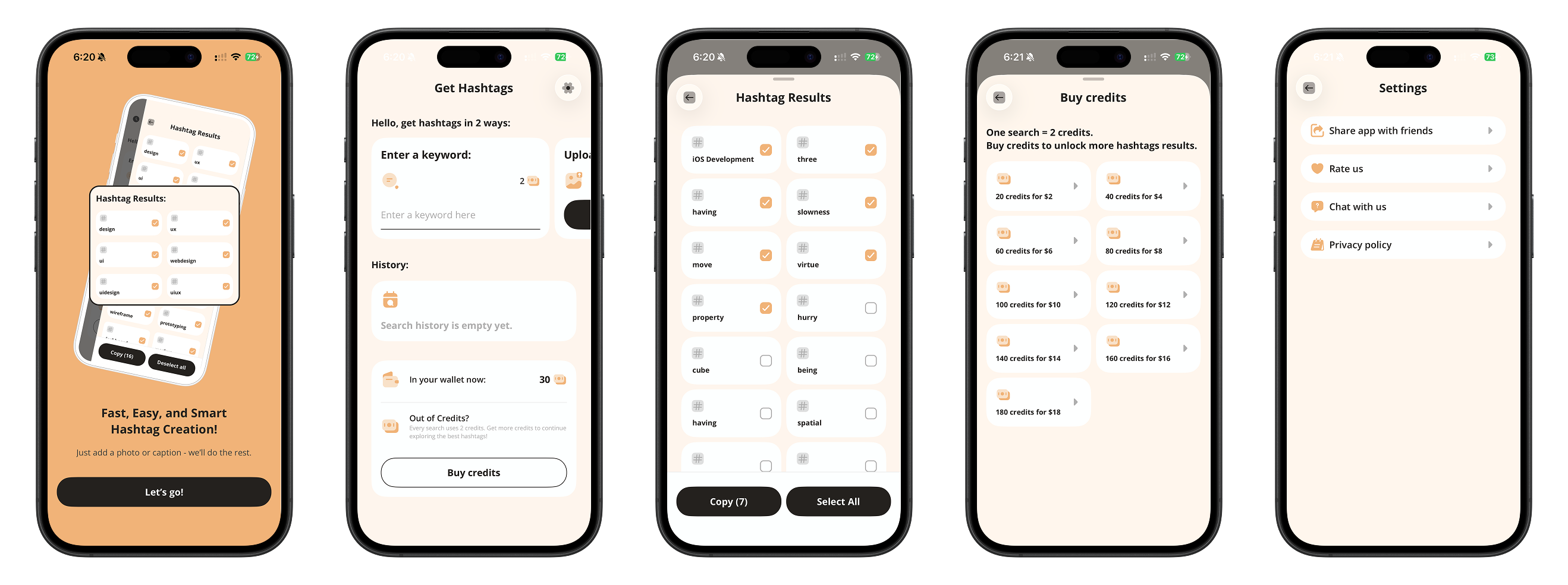
HashtagGenerator is an iPhone app that generates hashtags via an existing backend API. The app focuses on fast input (keyword or image), clean results selection/copy, history, and a local credit wallet with in-app purchases. I delivered a buildable Xcode project and handled follow-up changes and bug fixes. Key highlights:
- API-driven hashtag generation (no on-device ML) for text and images
- Credit wallet persisted in Keychain; StoreKit 2 purchases add credit packs
- SwiftUI app with clear layering, event-driven updates, and SwiftData history
Problem
- Backend owned hashtag generation, so the client app needed to be reliable, lightweight, and UI-first.
- Credits had to be stored locally (no backend ledger) and survive typical reinstalls.
- IAP needed realistic pricing in production, but testable flows in the simulator.
Solution
I implemented two generation flows hitting a single endpoint: text tags and image tags (base64). Results are shown in a selectable grid with copy actions, and each generation is saved to history. Credits gate generation and are refilled via IAP, with a starter credit grant on first launch.
Architecture
- Layered SwiftUI codebase: Features (UI) / Domain (use cases) / Data (repos, StoreKit, HTTP) / Shared (design system)
- AppContainer composition root wiring SwiftData, Keychain storage, HTTP client, and event bus
- Router for navigation, sheets, and full-screen flows
- Use cases: GenerateHashtags, FetchCredits, BuyCredits, History read/write
- Networking with RequestBuilder + middleware chain (extra headers + structured network logger)
- SwiftData History model with transactional saves via TransactionRunner + SaveNotifier
- StoreKit 2 purchase flow + transaction updates listener to reconcile async purchases
Hard problems solved
- Implemented local-credit economics that persists via Keychain across restarts and typical reinstall scenarios (with clear limitations)
- Built a testable IAP pipeline: live StoreKit product pricing on device, StoreKit config scaffolding for simulator testing
- Kept the API contract strict: sanitized keyword inputs, compressed + base64 image payloads, and typed request bodies per req_type
- Prevented UI drift from Figma by standardizing sheets/menus using native iOS components and a small design system
- Ensured credit accounting stays consistent across explicit purchases and StoreKit transaction updates
- Reproduced and fixed a camera/photo-picker regression (both actions opening the gallery) by replacing the photo input component
Impact / Results
- Delivered the requested app as a buildable Xcode project aligned with provided Figma screens
- Added post-delivery changes (starter credits, UX improvements) and provided targeted patch fixes quickly
- Left a maintainable foundation for future auth or backend-led credit tracking if needed
Tech stack
- iOS: Swift, SwiftUI, StoreKit 2, SwiftData, Keychain
- Architecture: Layered Features/Domain/Data, use cases + repositories, Router navigation, event bus
- Backend/Infra: REST API (image/text generation), base64 image upload
- Tooling: Xcode, StoreKit Configuration (simulator), network middleware + structured logging

Contact
Need this kind of app work?
Tell me what you’re shipping, stabilizing, or modernizing.
Dan Kurman · Daniyar Kurmanbayev