
Role
Outcome
PoC delivered; further work paused by client
Stack
SwiftUI · Nearby Interaction · MPC · Rust · H3
What this proves
Selected work from the build
- NI token exchange + direction UI validated on supported devices/regions
- Modular P2P layer with testable payload transfer (including audio)
- Rust core via UniFFI for H3-gated peer graphs and snapshot syncing
Visuals
Product walkthrough
Tap or click the preview to open it fullscreen.
Case study
A closer look at the problem, implementation choices, and outcome.
Quick facts
- Role: Lead iOS engineer (PoC delivery + architecture)
- Timeframe: Multi-milestone engagement
- Platform: iOS (SwiftUI), iPhone 15+ for NI/UWB testing
- Status: PoC delivered; further work paused by client
- Team: 1 (with client stakeholders)
Summary
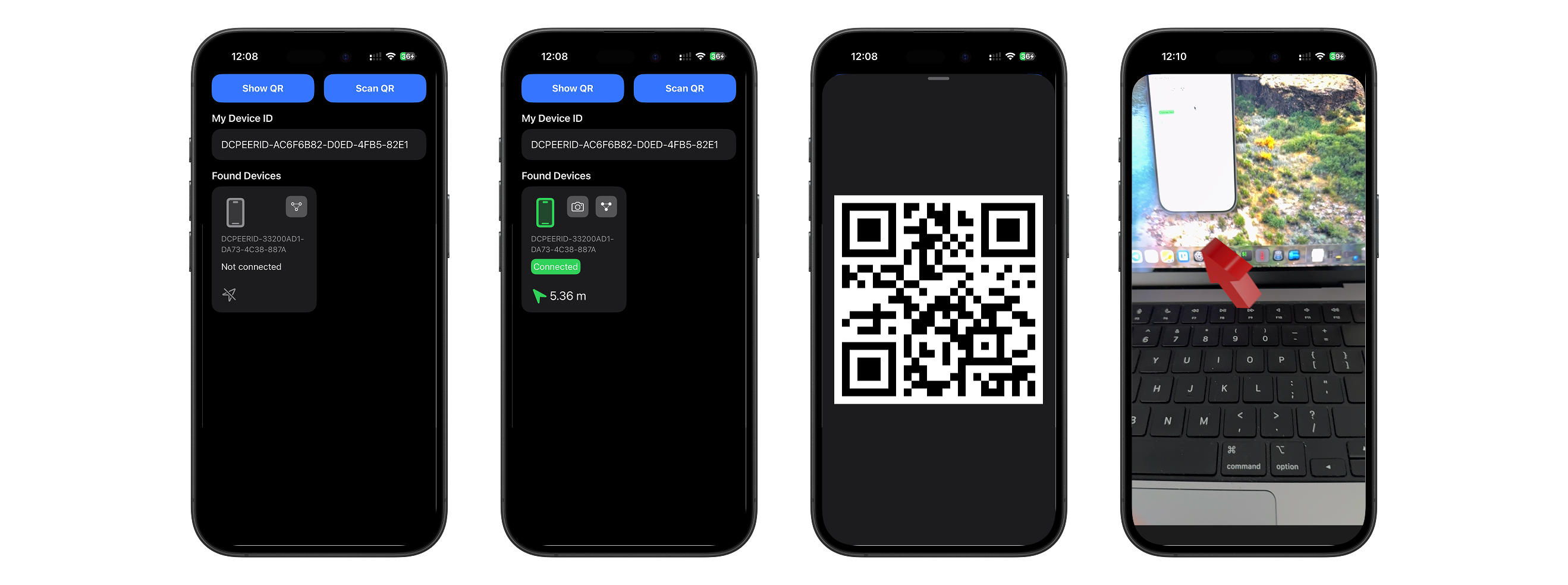
DeviceCluster is a privacy-centric PoC for spontaneous, close-proximity connections between nearby users. It combines Multipeer Connectivity for discovery and transport, Nearby Interaction for direction/distance when available, and a modular foundation to swap transports and add backend orchestration later. The work expanded into clustering logic, QR-based pairing, AR direction cues, and a Rust core for portable graph modeling. Key highlights:
- NI token exchange + direction UI validated on supported devices/regions
- Modular P2P layer with testable payload transfer (including audio)
- Rust core via UniFFI for H3-gated peer graphs and snapshot syncing
Problem
- Accurate “mutual direction” between two moving phones is hard and easy to fake with sample code.
- UWB/Nearby Interaction behavior is environment-dependent (region/device/entitlements) and fails silently.
- Always-on proximity scanning is constrained by iOS background limits, and NFC “tap-to-pair” isn’t available for true iPhone-to-iPhone exchange.
Solution
I built a PoC that discovers nearby devices, connects peer-to-peer, exchanges NI discovery tokens, and renders live direction/distance when supported. When platform constraints blocked seamless discovery, I added fallback and orchestration primitives: QR pairing, websocket readiness, and a tiered clustering approach that can escalate from coarse location to close-range precision.
Architecture
- SwiftUI app with a dedicated connectivity layer (Multipeer Connectivity) and clear feature boundaries
- NI manager: token exchange → NISession start → publish distance/direction → UI arrow binding
- Fallback pairing: QR generator + scanner (AVFoundation) to bootstrap peer connection
- AR overlay: simple camera-space arrow view tied to peer direction updates
- Websocket client layer behind reusable networking components for backend coordination
- Rust core via UniFFI: H3-based location gating + petgraph undirected cluster graph
- Snapshot broadcast over P2P with debounced sending and minimal “apply then suppress re-broadcast” logic
Hard problems solved
- Diagnosed NI “session suspends immediately” behavior and isolated the root constraint to regional UWB availability, then validated on the client’s supported devices
- Built a peer-to-peer NI token exchange path that recovers from suspension/invalidation by re-sending tokens and re-running sessions
- Evaluated Wi-Fi Aware and rejected it due to non-automatable pairing UX (system code sheet, no programmatic access)
- Implemented reliable, higher-payload peer messaging (audio transfer) to validate transport beyond tiny control messages
- Designed a tiered discovery strategy to work with iOS backgrounding limits (coarse triggers → P2P channels → NI precision layer)
- Integrated Rust via UniFFI + XCFramework build pipeline and exposed a safe Swift API for graph snapshots and H3 gating
- Implemented basic snapshot syncing and documented remaining gaps (versioning/conflict resolution) instead of hiding them
Impact / Results
- Delivered a working PoC proving peer discovery + direction cues are feasible on supported devices
- Produced a modular foundation: connectivity, pairing, AR visualization, clustering core, and backend-readiness hooks
- Helped the client make informed product decisions by surfacing platform constraints early (UWB region limits, NFC limits, Wi-Fi Aware UX)
Tech stack
- iOS: Swift, SwiftUI, NearbyInteraction, MultipeerConnectivity, ARKit, AVFoundation
- Architecture: Clean modular services/repos + use cases, payload framing, snapshot-based sync
- Backend/Infra: WebSockets (echo endpoint for validation), location-based gating with H3
- Tooling: Rust, UniFFI, XCFramework/Swift Package packaging, Xcode, os.Logger

Contact
Need this kind of app work?
Tell me what you’re shipping, stabilizing, or modernizing.
Dan Kurman · Daniyar Kurmanbayev