
Role
Outcome
Completed (academic project)
Stack
Python · YOLOv5 · Detectron2 · TensorFlow OD · Roboflow
What this proves
Selected work from the build
- Compared SSD-ResNet50, YOLOv5, and Faster R-CNN pipelines on the same labeled dataset
- Used Roboflow augmentation to scale the dataset and standardize labels
- Shipped a prediction endpoint returning letter, bounding box, and confidence
Visuals
Product walkthrough
Tap or click the preview to open it fullscreen.
Case study
A closer look at the problem, implementation choices, and outcome.
Quick facts
- Role: ML Engineer (Computer Vision) + Backend Developer (demo API)
- Timeframe: Not specified
- Platform: Model training + REST API demo
- Status: Completed (academic project)
- Team: Team project
Summary
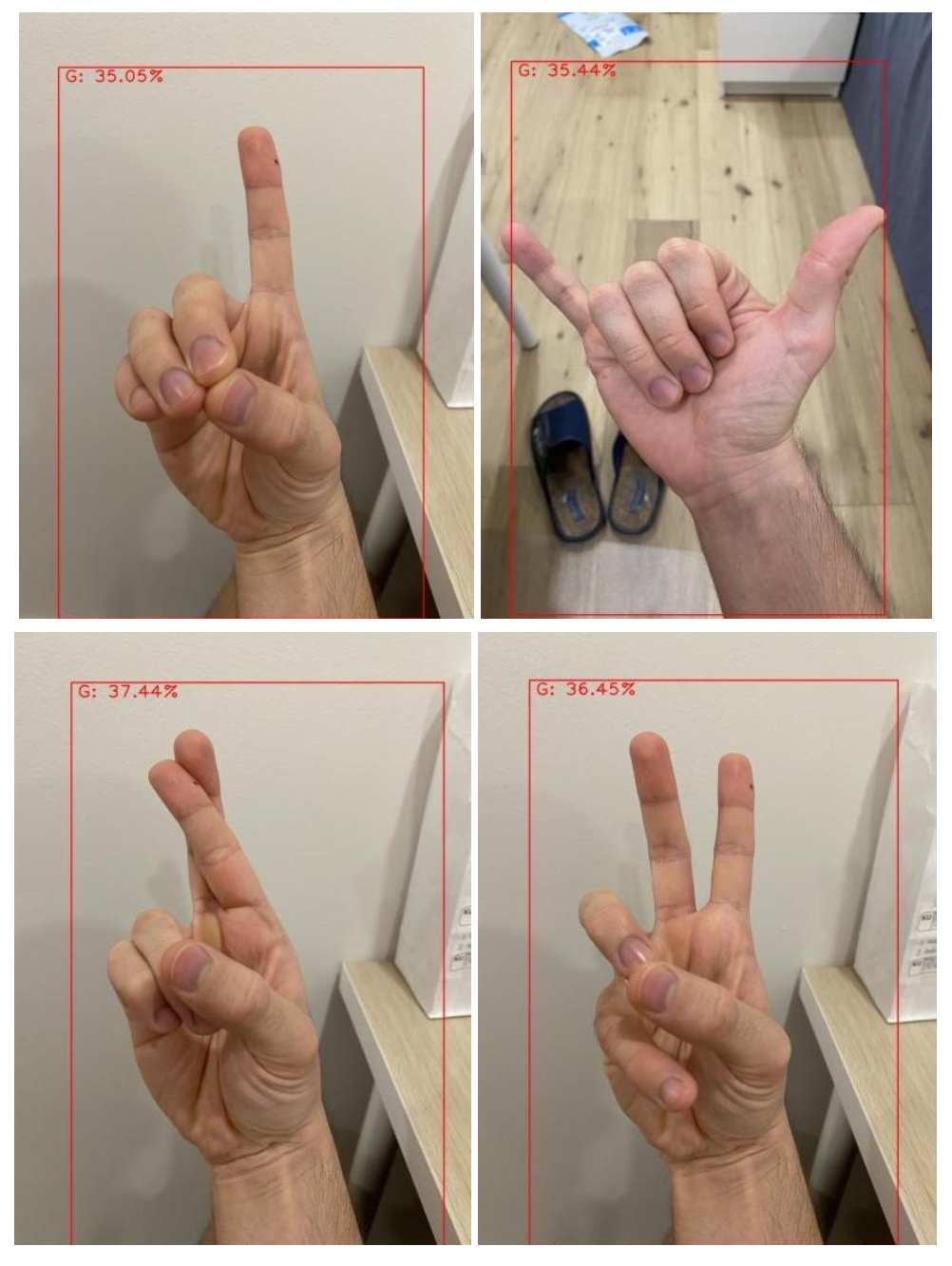
American Sign Language alphabet recognition from images. The goal was to localize the hand and classify the sign into one of 26 letters. We evaluated multiple object-detection approaches (SSD, YOLOv5, Faster R-CNN), used transfer learning, and built a simple Django API for inference demos. Key highlights:
- Compared SSD-ResNet50, YOLOv5, and Faster R-CNN pipelines on the same labeled dataset
- Used Roboflow augmentation to scale the dataset and standardize labels
- Shipped a prediction endpoint returning letter, bounding box, and confidence
Problem
- Needed both localization (bounding box) and classification (26 classes) with limited labeled data.
- Training compute was constrained early (no GPU), forcing careful iteration choices.
- Offline validation metrics did not translate to real-world video performance.
Solution
We framed the task as object detection and used transfer learning to accelerate progress. Data was augmented via Roboflow (rotations and flips) to increase per-class coverage. We then benchmarked SSD-ResNet50 vs YOLOv5 vs Faster R-CNN, focusing on the gap between validation metrics and live inference. For the demo, we wrapped inference behind a Django REST endpoint that accepts an image and returns the predicted letter, bounding box, and score.
- Prioritized a reproducible pipeline over a single “best” model
Architecture
- Dataset: Kaggle ASL alphabet images (26 classes) with existing annotations
- Preprocessing: Roboflow augmentation + train/val/test split + COCO/YOLO export formats
- Models: transfer learning on SSD-ResNet50 (TF Object Detection Zoo), YOLOv5, Faster R-CNN (Detectron2)
- Training: GPU-enabled runs for longer training schedules; tracked loss and detection metrics
- Evaluation: compared validation metrics vs real-world tests (video inference)
- Demo: Django API endpoint → model inference → JSON response (class, box, score)
Hard problems solved
- Managed compute constraints: early SSD training was too slow without GPU, forcing a model strategy change
- Diagnosed metric vs reality mismatch: high validation scores but poor live video accuracy
- Built a consistent labeling pipeline across frameworks (TF OD API, YOLO format, COCO JSON)
- Tuned augmentation to increase data volume while monitoring degradation in generalization
- Investigated failure modes separately for box regression vs class prediction (correct box, wrong class)
- Packaged inference into an API that returns structured outputs suitable for a front-end demo
Impact / Results
- Produced an end-to-end ASL alphabet detection pipeline with multiple model baselines
- Demonstrated that offline metrics can be misleading without real inference testing
- Delivered a working inference API for demo usage (image in → prediction out)
Tech stack
- Architecture: Transfer learning, object detection (SSD / YOLOv5 / Faster R-CNN)
- Backend/Infra: Django, REST API, Detectron2, TensorFlow Object Detection Zoo
- Tooling: PyTorch, Roboflow, Kaggle dataset, Google Colab/local GPU training

Contact
Need this kind of app work?
Tell me what you’re shipping, stabilizing, or modernizing.
Dan Kurman · Daniyar Kurmanbayev