
Role
Outcome
Shipped
Stack
UIKit · RxSwift · Moya · Firebase
What this proves
Selected work from the build
- Built v1 end-to-end: auth, address, catalog, cart/workflow, and profile
- Clean layered architecture with MVVM + RxSwift and Moya networking
- Strong workflow/session handling across the app via shared headers and events
Visuals
Product walkthrough
Tap or click the preview to open it fullscreen.
Case study
A closer look at the problem, implementation choices, and outcome.
Quick facts
- Role: Lead iOS Developer (led v1 build)
- Timeframe: V1 delivery + early iterations
- Platform: iOS
- Status: Shipped
- Team: iOS lead within a product team
Summary
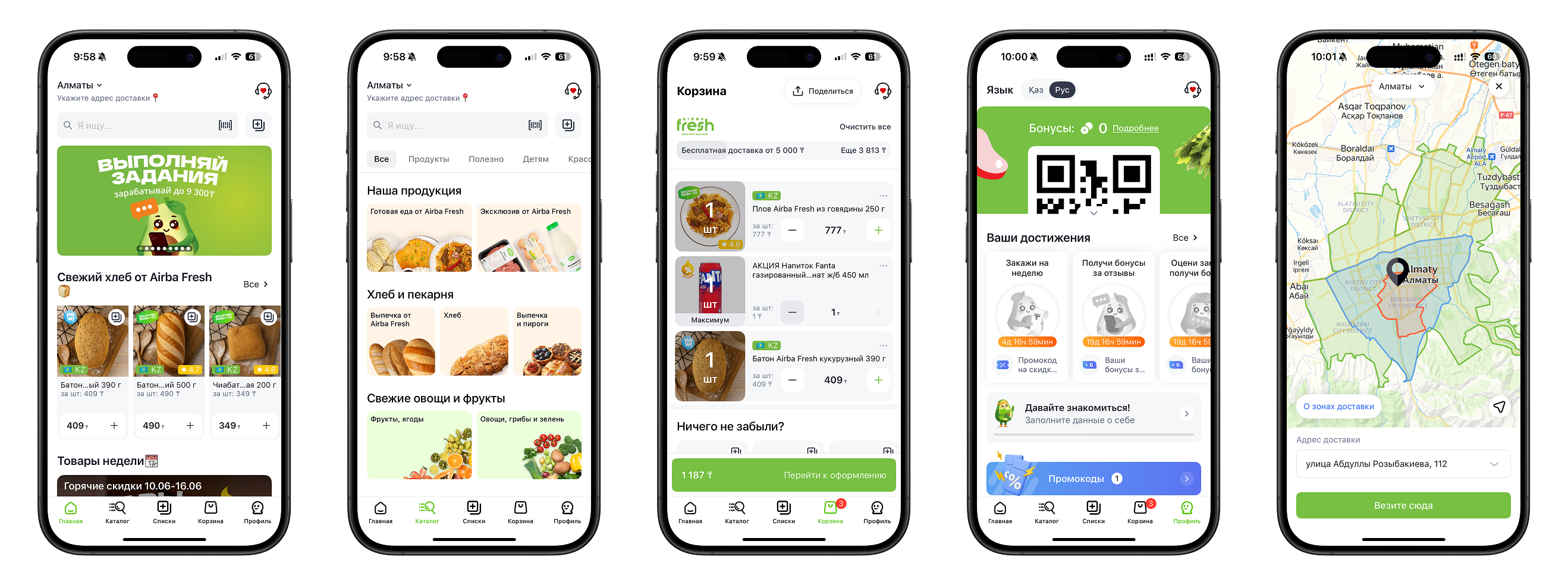
Airba Fresh is a grocery delivery app focused on fast browsing, search, and checkout driven by delivery address and the nearest warehouse. I led the iOS development of the first version, setting up the architecture, core flows, and delivery-ready feature set. Key highlights:
- Built v1 end-to-end: auth, address, catalog, cart/workflow, and profile
- Clean layered architecture with MVVM + RxSwift and Moya networking
- Strong workflow/session handling across the app via shared headers and events
Problem
- Grocery UX is state-heavy: address, warehouse availability, promotions, cart, and delivery slots must stay consistent.
- Catalog needed scalable filtering, search, product availability states, and fast product detail loading.
- App had to support both guest browsing and gated actions (addresses, favorites, ordering) without confusing users.
Solution
I implemented a tab-based shopping flow with address-first delivery context, a category catalog with search and filters, and a workflow-driven cart/session that stays consistent across screens. The app supports guest browsing, then escalates to auth only when needed.
- Address selection drives assortment, delivery eligibility, and order readiness
Architecture
- Layered structure: Data (DTO/API/Storage) → Domain (services/repos) → Presentation (MVVM) → Application (factories/coordinator)
- Networking via Moya targets with a single base URL and unified target conventions
- Workflow/session propagated to all requests through a custom Moya plugin header
- Reactive state with RxSwift/RxCocoa (PublishRelay) across services and view models
- App-wide events via EventManager (unauthorized, data refresh, limit events)
- DTO → Entity → UI mapping for catalog, sections, and product details
- Shared workflow repository emits cart count and session changes to update UI globally
- Address CRUD + suggestions/geocoding integrated via a dedicated service layer
Hard problems solved
- Made workflow/cart a first-class shared state and ensured every request carried the right context without leaking it into feature code
- Designed a reactive update model so catalog, product detail, and cart screens stay consistent after mutations (add/remove/qty)
- Built clean boundaries between “nomenclature” (catalog) and workflow/cart to avoid circular dependencies
- Handled auth/unauthorized events globally and safely reset session, repositories, and workflow without stale UI
- Implemented address gating rules (guest vs authorized paths) while keeping navigation predictable
- Ensured search/filter flows degrade cleanly (empty states, clear filter confirmation, out-of-stock states)
Impact / Results
- Delivered the first production version of the iOS app as the iOS lead
- Established a maintainable architecture that supported multiple feature areas and ongoing iteration
- Shipped a stable shopping flow across address, catalog, cart, promotions, and profile
Tech stack
- iOS: Swift, UIKit, RxSwift/RxCocoa
- Architecture: MVVM, Coordinator, layered Data/Domain/Presentation, event bus
- Backend/Infra: REST API (Moya targets), Yandex geocoding/suggest integration
- Tooling: CocoaPods, SnapKit, Kingfisher, Husky (pre-commit), SwiftFormat, xUnique



Contact
Need this kind of app work?
Tell me what you’re shipping, stabilizing, or modernizing.
Dan Kurman · Daniyar Kurmanbayev